I'm happy to announce that my new article on gender performance in Dance Central is now available from the journal New Media & Society, published online-before-print. Once the print edition is published, I'll be permitted to post a link to a full-text version for those who don't have subscription access to the journal. Please note, this is a very short article by my standards (I struggled with the journal's strict word-count limit). I have a lot more to say about this topic in future work! Comments are very welcome.
Miller, Kiri. 2014. "Gaming the System: Gender Performance in Dance Central". New Media & Society, http://nms.sagepub.com/content/early/2014/01/21/1461444813518878 (published 9 January 2014).
Abstract
This article investigates how the Dance Central game series (Harmonix Music Systems) invites and persuades players to experiment with gender performance. Dance Central uses the Xbox 360 Kinect, a motion-sensing interface, to teach players full-body dance routines set to popular club music. This study offers evidence that performative, constructivist gender theories informed the development process for these games, and explores what happens when designers enlist players in putting theory into practice. Dance Central stages visceral encounters with gendered choreography, generating both embodied gender work in the course of gameplay and reflective gender discourse in public-sphere social media. Grounded in qualitative ethnographic research that gives equal attention to interface affordances, game design, player experiences, and game-related discourse, this article offers a case study for understanding how digital media become enculturated as technologies of gender.
Keywords
Dance, design, digital games, embodiment, gender, gesture, interface, kinesthesia, play, social media
Tuesday, March 11, 2014


Thursday, April 11, 2013
PAX East 2013 & Dance Central player survey
After a long blog hiatus, I thought I'd get back in the swing of things with some notes from PAX East. I could only get up to Boston for a few hours (on March 22, 2013), so I spent all my time hanging out at the Dance Central booth on the exhibits floor and attending the "Rock Band Behind the Music" panel. The Harmonix folks posted their own Dance Central PAX recap, including some fantastic cosplay photos. I didn't take too many pictures, but here's one great crew in action.

I was struck by the diversity of the players who chose to get onstage (and who waited in line for quite a while for the privilege). They were diverse in terms of conventional demographic categories like age, gender, and race/ethnicity, but also things like sartorial style, dance expertise, and prior knowledge of the Dance Central repertoire. I saw several pairs of dancers in which one person knew the choreography cold while his/her friend was mostly freestyling along, without any concern for earning points. A toddler who clearly had some DC experience was having an awesome time at the edge of the stage; her mother was waiting in line to dance, and told me that at 17 months, her daughter already knows some game moves. A tween boy gave an incredible solo performance, starting with striking a pose with his back to us -- he reminded me of the Guitar Hero virtuosos who play with their backs to the TV. (He danced solo by his own request; usually people without a dance partner were joined by a friendly Harmonix staff member.) A late-middle-aged, conservatively-dressed white couple stood out from the crowd in this context; as they were preparing to go on stage, the husband (I assume) said it would be the most humiliating three minutes of his life, but he got up there anyway. Meanwhile, I kept an eye on my #dancecentral twitter feed, and caught some related commentary.

A few more observations:
After spending an hour or so at the Dance Central stage I headed up to wait in line for the Rock Band panel, which was popular to say the least. Here's what the hallway line looked like, from maybe 3/4 of the way back (and 20 minutes before the start time).

The panel was all about copyright and licensing issues for the Rock Band song repertoire, which is a fascinating, incredibly complex, and legally sensitive topic; they asked people not to record/tweet/blog the details of the presentation, apparently because there was some concern about somehow making trouble with artists/labels who could be important partners in the future. I counted the rows of filled seats and estimated at least 800 people in attendance. (I think my own academic talk audiences have maxed out at 200 at the very most -- thanks, Texas A&M! Always healthy to get a reality check in terms of who's doing the work of educating/influencing the public on issues like intellectual property and how licensing works.) In accordance with the wishes of the panelists, I won't give more details on the panel, except to share the incredible stats that over the life of the Rock Band franchise to date, there have been over 130 million song downloads and over 23,766,000 gems authored by the audio team (the "gems" in Rock Band notation tracks are the equivalent of individual notes on printed sheet music -- most of them are hand-placed, based on painstaking listening and transcription work). My takeaway from the panel was that Harmonix wanted to give players a sense of the incredible amount of work (legal, musical, coding, etc.) that went into producing the Rock Band repertoire, explaining why "we're not a short-order cook", i.e., why they couldn't immediately license, produce, and distribute all the specific songs requested by players over the years. The audience seemed appreciative, and not a little wistful, since this was all coming shortly after the announcement of the end of Rock Band DLC releases.
In other news, I've been working away on my Dance Central research project and just put together a player survey. Web-based surveys played an important role in my previous research projects on Grand Theft Auto and Guitar Hero/Rock Band, and I'm hoping to learn a lot from this one as well. Please spread the link around to anyone who might be interested in sharing their experience. This isn't really about making a claim to "hard data" or reaching a statistically significant sample of DC players (though that would be cool). Instead, it's another way to learn about the diversity of player experiences, and to check my own ideas against as many other sources as possible.
Happy spring to all!

I was struck by the diversity of the players who chose to get onstage (and who waited in line for quite a while for the privilege). They were diverse in terms of conventional demographic categories like age, gender, and race/ethnicity, but also things like sartorial style, dance expertise, and prior knowledge of the Dance Central repertoire. I saw several pairs of dancers in which one person knew the choreography cold while his/her friend was mostly freestyling along, without any concern for earning points. A toddler who clearly had some DC experience was having an awesome time at the edge of the stage; her mother was waiting in line to dance, and told me that at 17 months, her daughter already knows some game moves. A tween boy gave an incredible solo performance, starting with striking a pose with his back to us -- he reminded me of the Guitar Hero virtuosos who play with their backs to the TV. (He danced solo by his own request; usually people without a dance partner were joined by a friendly Harmonix staff member.) A late-middle-aged, conservatively-dressed white couple stood out from the crowd in this context; as they were preparing to go on stage, the husband (I assume) said it would be the most humiliating three minutes of his life, but he got up there anyway. Meanwhile, I kept an eye on my #dancecentral twitter feed, and caught some related commentary.

A few more observations:
- a couple turned to orient themselves toward each other (away from the screen) during freestyle
- most people seemed to have a favorite avatar, or at least took the trouble to change characters before they started (hard to know whether they were making choices on the spot or had a go-to choice established)
- a few people were singing along or lip-syncing along as they danced
- there was some evidence of minor confusion from learning moves from two-dimensional images: for instance, actually holding one's elbow with the opposite hand during the lasso moves in "Gangnam Style" vs. just keeping arms close to that position (I can't say for sure whether this was based on visual confusion; it could also be an effort to self-constrain the arms into the angles that will earn credit for the move). I've observed a similar issue for snapping fingers in some songs (you can't hear the finger-snaps in the game, so some people just register it as a way of holding the hand).
- PAX players also exhibited the extremely common DC practice of keeping their heads up and eyes oriented toward the screen, even when the on-screen dancer is doing otherwise. "Gangnam Style" offers a prime example of this, too, especially for the down-on-the-floor section -- see for example this excellent player in Brazil:
After spending an hour or so at the Dance Central stage I headed up to wait in line for the Rock Band panel, which was popular to say the least. Here's what the hallway line looked like, from maybe 3/4 of the way back (and 20 minutes before the start time).

The panel was all about copyright and licensing issues for the Rock Band song repertoire, which is a fascinating, incredibly complex, and legally sensitive topic; they asked people not to record/tweet/blog the details of the presentation, apparently because there was some concern about somehow making trouble with artists/labels who could be important partners in the future. I counted the rows of filled seats and estimated at least 800 people in attendance. (I think my own academic talk audiences have maxed out at 200 at the very most -- thanks, Texas A&M! Always healthy to get a reality check in terms of who's doing the work of educating/influencing the public on issues like intellectual property and how licensing works.) In accordance with the wishes of the panelists, I won't give more details on the panel, except to share the incredible stats that over the life of the Rock Band franchise to date, there have been over 130 million song downloads and over 23,766,000 gems authored by the audio team (the "gems" in Rock Band notation tracks are the equivalent of individual notes on printed sheet music -- most of them are hand-placed, based on painstaking listening and transcription work). My takeaway from the panel was that Harmonix wanted to give players a sense of the incredible amount of work (legal, musical, coding, etc.) that went into producing the Rock Band repertoire, explaining why "we're not a short-order cook", i.e., why they couldn't immediately license, produce, and distribute all the specific songs requested by players over the years. The audience seemed appreciative, and not a little wistful, since this was all coming shortly after the announcement of the end of Rock Band DLC releases.
In other news, I've been working away on my Dance Central research project and just put together a player survey. Web-based surveys played an important role in my previous research projects on Grand Theft Auto and Guitar Hero/Rock Band, and I'm hoping to learn a lot from this one as well. Please spread the link around to anyone who might be interested in sharing their experience. This isn't really about making a claim to "hard data" or reaching a statistically significant sample of DC players (though that would be cool). Instead, it's another way to learn about the diversity of player experiences, and to check my own ideas against as many other sources as possible.
Happy spring to all!
Tuesday, February 21, 2012
Playing Along -- now in print!

I've been so busy with the new semester that I failed to announce my own book launch! Playing Along: Digital Games, YouTube, and Virtual Performance was published earlier this month by Oxford University Press. Here's the official publisher page and the Amazon page (available for Kindle!). The awesome cover design is by Benjamin Shaykin.
Friday, January 13, 2012
Virtual Transmission, Visceral Practice: Dance Central and the Cybershala [SEM 2011]
I presented this paper at the joint meeting of the Society for Ethnomusicology and the Congress for Research on Dance in Philadelphia, PA (November 17-20, 2011). The Dance Central section represents my current research project (still in its early stages); the cybershala section is condensed from a longer treatment in my new book, Playing Along.
***
Virtual Transmission, Visceral Practice: Dance Central and the Cybershala
Interactive digital media technologies are gradually transforming the face-to-face, body-to-body transmission contexts that have always played a crucial role in music and dance pedagogy. YouTube, blogging platforms, and other online social media forums have given rise to countless virtual communities of practice. Meanwhile, digital game developers are seeking to bridge the gap between virtual and visceral experience by creating new kinds of controllers, motion-sensing devices, and gestural interfaces (e.g., those employed by the Nintendo Wii and Xbox Kinect). Despite the limitations of current technologies, millions of people are turning to online media and digital games in the pursuit of new corporeal skills, experiences, and knowledge.
Today I’m going to present two case studies in techno-mediated transmission. First I’ll address the “cybershala” created by yoga bloggers, a web-based community of practice that sometimes comes into conflict with traditional authority. Then I’ll turn to Dance Central, a videogame that teaches players full-body choreography routines set to popular club music, offering real-time feedback using a motion-sensing camera peripheral. While time limitations will prevent me from doing justice to either case study, I think it’s worth our while to consider how they inform each other. These examples illustrate some new possibilities for the transmission of embodied practice, for converting virtual social connections into visceral common knowledge, and for imagining what it’s like to live in someone else’s body.
Cybershala: The Ashtangisphere Never Sleeps
One day in the summer of 2010 a friend posted a comment on one of my Facebook status updates, asking how my backbends were coming along.

My friend and I both practice ashtanga yoga, a method codified and popularized in the twentieth century by Sri K. Pattabhi Jois (1915–2009) through his Ashtanga Yoga Institute in Mysore, India. Ashtanga is a “flowing” yoga style, in which most asana (postures) are held for only five breaths; fluid transitions between asana are an integral part of the practice. The simplest explanation of what makes ashtanga distinctive is that practitioners always move through the asana in a particular order, matching their movements to a particular breath pattern. The prescribed sequence of asana is broken down into a structured curriculum: fundamentals, primary series, second series, and so on. Students learn each series through cumulative repetition, with the teacher deciding when a student is ready to add a new asana or begin a new series. In “Mysore-style” classes, the teacher does not instruct the whole group and rarely demonstrates asana. Instead, she or he moves through the room giving physical adjustments and working with students one-on-one as they each proceed through the series. [Hey ashtangis, I know this description is woefully incomplete, but this talk could only be 20 minutes long!]

At the time of our Facebook exchange my friend and I were both partway through learning the second series, 3,000 miles apart and working with different teachers. The ashtanga curriculum offers a structuring framework for online discourse and visceral common knowledge. (Cf. Hamera 2007 on how dance builds "relational infrastructure".) Everyone who practices second series knows exactly what it means when I say that I am working on kapotasana; they have their own sensational knowledge of that asana. If the asana came more easily to them than to me, then they also have a visceral understanding of the differences between our bodies.
An overwhelming number of yoga blogs, videos, Facebook updates, Twitter feeds, and other forms of online social media now constitute a “cybershala” of ashtanga yoga practitioners—many who work with teachers regularly, others who are cultivating a practice as “home ashtangis” (cf. Finnegan 1989 on “hidden musicians”). Yoga bloggers face a challenge familiar to ethnomusicologists and dance scholars: how can one communicate kinesthetic, multisensory experiences without bodily presence and a shared sensorium? Home ashtangis have adopted exactly the same tactics that the anthropologist Jaida Kim Samudra advocates for scholars writing about kinesthetic cultures: first, attempting to “linguistically record the minute details of one’s bodily training” even when this is explicitly discouraged in traditional transmission (2008:670); second, being attentive to one’s own internal bodily sensations in order to better comprehend other practitioners’ experiences (674); and finally, creating “somatic narratives,” which comprise both “the series of actions narrated by bodies during limited frames such as practice sessions, performances, or competitions” and “the stories people tell about what happened to and with their bodies during specific events” (674). Yoga bloggers often combine video, still images, and lengthy written accounts to communicate these somatic narratives online.
As I watched the videos my friend recommended, my body shifted in my desk chair as though operated by remote control: back straightening, shoulder blades sliding together, legs subtly rotating in hip sockets, toes spreading to grip the floor for a vicarious backbend. I heard myself breathing. I experienced the blogs and videos through my accumulated “sensational knowledge” (Hahn 2007), just as I had learned to reenact my teacher’s physical adjustments while alone on my mat—the virtual hand drawing my hip back, the virtual foot nudging the angle of my own foot on the floor, the virtual arm stopping me from taking my legs past vertical in a headstand. It was very much like the experience of listening to music that I knew how to play.
Watching these videos also gave me the uncomfortable feeling that I might be cheating on my teacher. Ashtanga students are not supposed to start experimenting with advanced asana of their own accord. On the other hand, the structured nature of ashtanga makes it particularly well suited to independent practice, amateur-to-amateur pedagogy, and online discourse among a dispersed community of practitioners. Browsing YouTube videos of ashtanga backbends quickly led me to “grimmly2007,” who had uploaded about 300 videos so that he could embed them in his yoga blog.
Grimmly is an ashtanga student without a teacher—an impossible contradiction to many practitioners, but one that is getting more possible all the time. He lives in the United Kingdom and works as a repairer of woodwind instruments. In early 2007, Grimmly’s flat was burgled and seven saxophones were stolen. This incident made him so angry, and then so irritated with his own anger, that he decided to take up some form of meditation. In the course of reading about meditation practices, he learned that “a lot of meditators were also doing yoga,” so he looked for a yoga book at the library and found Tara Fraser’s Total Astanga (Fraser 2006). As an overweight 43-year-old man, he was a bit embarrassed even bringing the book up to the circulation desk. On his blog, he wrote, “Going to a yoga class wasn’t something I even considered. A guy here, outside London, might think about going to a gym to get in shape but not a Yoga class, probably not even an aerobic class” (Grimmly 2010: part 1).
Grimmly began learning the sequence of asana from the book, practicing every morning before work, and soon began to order instructional DVDs and search for YouTube videos to help him develop his practice. He started his yoga blog in the summer of 2008, after about a year and a half of practicing at home alone six days a week. His posts often invoke a growing community of hidden “home ashtangis” like himself:

The blog was originally intended to document his progress on the “jump-back,” a transition between many asana. Grimmly eventually produced 57 posts on the jump-back, many including slow-motion videos of himself and other practitioners.
As Grimmly developed his home practice, some of his choices posed challenges to ashtanga orthodoxy. For instance, when Grimmly blogged about his decision to begin learning the second series of asana, one commenter told him that he should not be learning any intermediate asana before he could stand up from a backbend: “Then and only then you start to add intermediate to your existing primary. Your teacher would give you each new asana as he saw your progress. . . . Traditionally in India, yoga has been learned from teacher to student, not from a book or video. It’s really not right to decide to give yourself postures” (Sophia, comments posted on Grimmly 2008a).
When making such claims about traditional practice, ashtanga practitioners often invoke the ultimate authority: “how it’s done in Mysore,” at the Ashtanga Yoga Institute. But in this case another commenter offered evidence that the teaching method in Mysore had changed over time. Ursula, a woman from Germany, reported that at the Mysore shala she had been given the first pose of the intermediate series before she could stand up from a backbend. When another commenter suggested that this experience might have been “an aberration,” Ursula responded by invoking the higher authority of her own bodily experience: “Sorry to write this, but what I see is that people hanker for rules, because there is so much insecurity. . . . Why should I not do these softer back bendings which are good for the back? Only because there are rules, nobody really knows who invented them. . . . I listen to my body.” This discussion continued at length, showing how the print medium and time-delayed norms of comment threads have encouraged the development of cybershala discourse. Discussants can take time to craft their replies and cite their sources, which in this case revealed the fluidity of “official” ashtanga pedagogy in Mysore.
After a year and a half of home practice, Grimmly finally decided to try attending an ashtanga class at a shala. He went two Sundays in a row and was “blown away” by the physical adjustments he received from the teachers there. But a week later, he explained that he doubted he’d go back: “All the time it’s just been me on my mat, alone in a room early each morning, my practice…Somehow now, after visiting the Shala, it feels a little like I’m practicing for someone else…I feel more distant from my practice, less involved” (Grimmly 2008b). It’s clear from other posts that Grimmly developed his practice using books, famous teachers’ DVDs, YouTube videos, other students’ blogs, and any other media resources he could find. He often writes about insights gleaned from these sources. Nevertheless, the “live” teaching at the shala somehow alienated him from his practice. While he benefited from the physical adjustments he received, he was willing to forego them in order to maintain a sense of agency and responsibility for his own development: practicing for himself instead of a teacher.
Dance Central: Dancing in Someone Else's Body?
At this point I’m going to turn to another form of home practice: the dance repertoire transmitted by Dance Central, a digital game created by Harmonix Music Systems (the company that brought you the Guitar Hero games). Dance Central teaches players to perform choreographed dance routines to popular club music tracks from the last few decades.
There is no game controller involved; instead, a motion-sensing camera is constantly tracking your body movements and sending data back to the game software. The on-screen dancer is your instructor and model, not your mirror or your puppet. Unlike a conventional game avatar, the on-screen dancer doesn't do what you do. If you miss a particular arm motion, the avatar’s arm will glow red to show you where you are making a mistake, but the avatar won’t actually perform your mistake.
Like the ashtanga cybershala, Dance Central offers people an opportunity to learn a physically challenging and culturally marked repertoire in private. Many people consider dancing to be a potentially humiliating activity. Those who do dance in public are subject to evaluation: in most social-dance genres, there are established norms for moving your body in a manner appropriate to your gender, sexual orientation, age, and sometimes your race or ethnicity. But what if you could learn to dance from a virtual instructor who objectively evaluates and gently corrects the technical accuracy of your moves, but who can't judge you on your coolness, your body shape, or whether your moves "match" your identity traits? Some players experience this possibility as liberating. Others remain uncomfortable, particularly when the game compels them to transgress gender norms. (I’m going to focus on gender and sexuality examples today, since I have such limited time, but there’s a lot to be said about racialized and cross-racial performance, too.) Let’s take a look at some posts on the official Dance Central web forum:
After the moderator called attention to the implied use of profanity and requested more “constructive” feedback, xXShadowFrostXx clarified:
[In case you don't feel like clicking to enlarge, here's the last bit:]
I’m sorry for that I just auto-censured myself lol. What I meant is that every songs should have a male and a female routine because as a guy, I do like by example: doing Just Dance routine because it’s one of my favorite but some moves are a little bit too girly to perform. I think it would be a good idea if both male and female routine could be similar but more suitable for our own gender, you know what I mean?
Here’s an example of a male player performing a dance that includes gender-coded moves. As you can see, he has garnered special praise on the Dance Central web forum for “actually dancing” rather than just going through the motions:
In an interview, another player (RiffRaff) told me that in the case of “Lapdance” he thought the Dance Central choreographers had deliberately included both “male” and “female” moves as a kind of sly joke on players: “It’s funny just how quickly the mood changes from like really rough guy moves to like really girly, girly moves….I thought they were kind of like drag-esque almost. It was a little too exaggerated…When I was first trying out the song, I was like, “What is this?” and I just started laughing because I just found it really funny how they snuck that in there….You already bought the track, so what are you going to do?”
It’s worth noting that players can select among several different male and female avatars for any song in the game. So ShadowFrost could choose to perform songs like “Lapdance” with a male avatar—but he evidently still experiences some moves as uncomfortably “girly”. One player suggested the opposite approach: he told ShadowFrost, “Try dancing with Emilia to those routines; they have become some of my favourites LOL” (Derek555, Dance Central forum reply). This player’s other posts about the avatar Emilia, which focus on the sexy spectacle of her performances, clarify his meaning here: he is suggesting that indulging in the pleasures of heterosexual voyeurism would offer an antidote to the girliness of the choreography, even as ShadowFrost was himself simultaneously performing that choreography. Along the same lines, one female player posts YouTube videos that show not her own dancing, but the performances of her male avatar:
As the player performs stereotypical female “stripper” moves, she can watch her male avatar perform the same moves against his gender type. Her videos are popular, and the comment threads are full of playful sexual fantasy:
There is a peculiar deferral of agency here: the dancing player submits his or her own body to the will of the game choreographers so that the player can in turn fetishize the dancing avatar.
But this is only one strategy for approaching the gender politics of Dance Central. Another involves “butching up” one’s approach to feminine moves. In an interview for a player’s video blog, one of the game choreographers offered some tips:
[A quick dialogue excerpt:]
Ricardo: Focus more on the arms. Like in "Rude Boy," you definitely see this going on: [moves hips]
MMC: You can’t hide from that.
Ricardo: Exactly! But what I do is -- and I still get a “Flawless” score! So I’m giving you guys tips on the game. Guys, just really like move more back and use your arms more. That takes away all of the things that may be uncomfortable for you, but being able to really like whip it down, the Kinect still sees that you’re doing the movement and still reads you as a flawless score….So you can focus more on the arms, and be more of a -- bam! -- masculine, dominant effect rather than being real roll-y.
Of course, some players embrace the opportunity to engage in cross-gender performance: either because they enjoy playing with their gender identity, or because they have unassailable confidence in a fixed gender identity and therefore recognize a satisfying technical and artistic challenge in the task of embodying another gender through dance.

For instance, this player told me, “I have received a few comments referring to my moves being too feminine or the choreo was too feminine for a straight guy to perform but I don't mind them at all. I considered them as compliments. Comments along those lines confirms that I performed the moves correctly.” Meanwhile, information in his YouTube profile and comment threads shores up his heterosexuality and his masculine cred: viewers learn that he has a wife and small child, and that he serves in the Navy.
I began this section by talking about Dance Central gameplay as a form of home practice, an unprecedented opportunity for totally private dance lessons and performance. So if part of the appeal lies in the privacy factor, why do I keep showing examples of Dance Central gameplay on YouTube? While there are doubtless many players who keep their dancing entirely private, Dance Central has also given rise to virtual communities of practice that look a lot like the ashtanga cybershala. Company-sponsored and fan-produced web forums, Twitter feeds, Facebook groups, blogs, and YouTube videos encourage the production and circulation of game-oriented discourse and performances.


Those who post performances to YouTube develop networks of friends and fans, with whom they also share the pleasures of defusing the inevitable “trolls” and “haters” who turn up in any comment thread.
A few concluding remarks
Both the cybershala and Dance Central make it possible for practitioners to learn a physically demanding, minutely codified repertoire without ever interacting with a physically-present teacher. Grimmly and his fellow cybershala practitioners are creating new transmission modalities for ashtanga yoga, from reflective writing to side-by-side slideshows that might reveal hidden traces of corporeal knowledge. Meanwhile, Dance Central players are learning hours of choreography while also working through their ideas about gender identity, public and private performance, and virtual community. These paradigm shifts in yoga and dance transmission might shed light on similar changes in the transmission of performing arts traditions that rely on a lineage of teachers and students, body-to-body pedagogy, and a codified repertoire or fundamental skill set. Dance Central and the cybershala show how professional game designers, home ashtangis, and living-room dancers are all finding ways to use available technology and social media platforms to support the virtual transmission of embodied practice.
Works cited
NB: Web materials are directly linked in the main text.
Finnegan, Ruth. 1989. The Hidden Musicians: Music Making in an English Town. Cambridge: Cambridge University Press.
Fraser, Tara. 2006. Total Astanga. London: Duncan Baird.
Hahn, Tomie. 2007. Sensational Knowledge: Embodying Culture Through Japanese Dance. Middletown, CT: Wesleyan University Press.
Hamera, Judith. 2007. Dancing Communities: Performance, Difference, and Connection in the Global City. New York: Palgrave Macmillan.
Samudra, Jaida Kim. 2008. "Memory in Our Body: Thick Participation and the Translation of Kinesthetic Experience." American Ethnologist 35(4):665-681.
POSTSCRIPT, January 2012
Just as I was finally getting around to reformatting this conference paper for the blog, Gamasutra published an article on gender and self-expression in Dance Central, featuring an interview with Dance Central project director Matt Boch. Clearly these issues aren't new to the folks at Harmonix.
***
Virtual Transmission, Visceral Practice: Dance Central and the Cybershala
 |
| screenshot from http://www.youtube.com/watch?v=kPFr27b86tE |
 |
| screenshot from http://www.youtube.com/watch?v=jS9ceH1xssk |
Interactive digital media technologies are gradually transforming the face-to-face, body-to-body transmission contexts that have always played a crucial role in music and dance pedagogy. YouTube, blogging platforms, and other online social media forums have given rise to countless virtual communities of practice. Meanwhile, digital game developers are seeking to bridge the gap between virtual and visceral experience by creating new kinds of controllers, motion-sensing devices, and gestural interfaces (e.g., those employed by the Nintendo Wii and Xbox Kinect). Despite the limitations of current technologies, millions of people are turning to online media and digital games in the pursuit of new corporeal skills, experiences, and knowledge.
Today I’m going to present two case studies in techno-mediated transmission. First I’ll address the “cybershala” created by yoga bloggers, a web-based community of practice that sometimes comes into conflict with traditional authority. Then I’ll turn to Dance Central, a videogame that teaches players full-body choreography routines set to popular club music, offering real-time feedback using a motion-sensing camera peripheral. While time limitations will prevent me from doing justice to either case study, I think it’s worth our while to consider how they inform each other. These examples illustrate some new possibilities for the transmission of embodied practice, for converting virtual social connections into visceral common knowledge, and for imagining what it’s like to live in someone else’s body.
Cybershala: The Ashtangisphere Never Sleeps
One day in the summer of 2010 a friend posted a comment on one of my Facebook status updates, asking how my backbends were coming along.

My friend and I both practice ashtanga yoga, a method codified and popularized in the twentieth century by Sri K. Pattabhi Jois (1915–2009) through his Ashtanga Yoga Institute in Mysore, India. Ashtanga is a “flowing” yoga style, in which most asana (postures) are held for only five breaths; fluid transitions between asana are an integral part of the practice. The simplest explanation of what makes ashtanga distinctive is that practitioners always move through the asana in a particular order, matching their movements to a particular breath pattern. The prescribed sequence of asana is broken down into a structured curriculum: fundamentals, primary series, second series, and so on. Students learn each series through cumulative repetition, with the teacher deciding when a student is ready to add a new asana or begin a new series. In “Mysore-style” classes, the teacher does not instruct the whole group and rarely demonstrates asana. Instead, she or he moves through the room giving physical adjustments and working with students one-on-one as they each proceed through the series. [Hey ashtangis, I know this description is woefully incomplete, but this talk could only be 20 minutes long!]

At the time of our Facebook exchange my friend and I were both partway through learning the second series, 3,000 miles apart and working with different teachers. The ashtanga curriculum offers a structuring framework for online discourse and visceral common knowledge. (Cf. Hamera 2007 on how dance builds "relational infrastructure".) Everyone who practices second series knows exactly what it means when I say that I am working on kapotasana; they have their own sensational knowledge of that asana. If the asana came more easily to them than to me, then they also have a visceral understanding of the differences between our bodies.
I’m
not really sure what the Cybershala is but I’ve heard it
referred to more and more lately. It seems to be an online community not
located at any one site or of a fixed membership. It seems to be made up of
blogs, comment threads and forums, corners of Facebook,
YouTube, chatrooms, and Skype
connections. Anywhere where one’s practice can be posted, discussed, commented
on . . .
An overwhelming number of yoga blogs, videos, Facebook updates, Twitter feeds, and other forms of online social media now constitute a “cybershala” of ashtanga yoga practitioners—many who work with teachers regularly, others who are cultivating a practice as “home ashtangis” (cf. Finnegan 1989 on “hidden musicians”). Yoga bloggers face a challenge familiar to ethnomusicologists and dance scholars: how can one communicate kinesthetic, multisensory experiences without bodily presence and a shared sensorium? Home ashtangis have adopted exactly the same tactics that the anthropologist Jaida Kim Samudra advocates for scholars writing about kinesthetic cultures: first, attempting to “linguistically record the minute details of one’s bodily training” even when this is explicitly discouraged in traditional transmission (2008:670); second, being attentive to one’s own internal bodily sensations in order to better comprehend other practitioners’ experiences (674); and finally, creating “somatic narratives,” which comprise both “the series of actions narrated by bodies during limited frames such as practice sessions, performances, or competitions” and “the stories people tell about what happened to and with their bodies during specific events” (674). Yoga bloggers often combine video, still images, and lengthy written accounts to communicate these somatic narratives online.
As I watched the videos my friend recommended, my body shifted in my desk chair as though operated by remote control: back straightening, shoulder blades sliding together, legs subtly rotating in hip sockets, toes spreading to grip the floor for a vicarious backbend.
Watching these videos also gave me the uncomfortable feeling that I might be cheating on my teacher. Ashtanga students are not supposed to start experimenting with advanced asana of their own accord. On the other hand, the structured nature of ashtanga makes it particularly well suited to independent practice, amateur-to-amateur pedagogy, and online discourse among a dispersed community of practitioners. Browsing YouTube videos of ashtanga backbends quickly led me to “grimmly2007,” who had uploaded about 300 videos so that he could embed them in his yoga blog.
 |
Grimmly began learning the sequence of asana from the book, practicing every morning before work, and soon began to order instructional DVDs and search for YouTube videos to help him develop his practice. He started his yoga blog in the summer of 2008, after about a year and a half of practicing at home alone six days a week. His posts often invoke a growing community of hidden “home ashtangis” like himself:

As Grimmly developed his home practice, some of his choices posed challenges to ashtanga orthodoxy. For instance, when Grimmly blogged about his decision to begin learning the second series of asana, one commenter told him that he should not be learning any intermediate asana before he could stand up from a backbend: “Then and only then you start to add intermediate to your existing primary. Your teacher would give you each new asana as he saw your progress. . . . Traditionally in India, yoga has been learned from teacher to student, not from a book or video. It’s really not right to decide to give yourself postures” (Sophia, comments posted on Grimmly 2008a).
After a year and a half of home practice, Grimmly finally decided to try attending an ashtanga class at a shala. He went two Sundays in a row and was “blown away” by the physical adjustments he received from the teachers there. But a week later, he explained that he doubted he’d go back: “All the time it’s just been me on my mat, alone in a room early each morning, my practice…Somehow now, after visiting the Shala, it feels a little like I’m practicing for someone else…I feel more distant from my practice, less involved” (Grimmly 2008b). It’s clear from other posts that Grimmly developed his practice using books, famous teachers’ DVDs, YouTube videos, other students’ blogs, and any other media resources he could find. He often writes about insights gleaned from these sources. Nevertheless, the “live” teaching at the shala somehow alienated him from his practice. While he benefited from the physical adjustments he received, he was willing to forego them in order to maintain a sense of agency and responsibility for his own development: practicing for himself instead of a teacher.
Dance Central: Dancing in Someone Else's Body?
At this point I’m going to turn to another form of home practice: the dance repertoire transmitted by Dance Central, a digital game created by Harmonix Music Systems (the company that brought you the Guitar Hero games). Dance Central teaches players to perform choreographed dance routines to popular club music tracks from the last few decades.
Like the ashtanga cybershala, Dance Central offers people an opportunity to learn a physically challenging and culturally marked repertoire in private. Many people consider dancing to be a potentially humiliating activity. Those who do dance in public are subject to evaluation: in most social-dance genres, there are established norms for moving your body in a manner appropriate to your gender, sexual orientation, age, and sometimes your race or ethnicity. But what if you could learn to dance from a virtual instructor who objectively evaluates and gently corrects the technical accuracy of your moves, but who can't judge you on your coolness, your body shape, or whether your moves "match" your identity traits? Some players experience this possibility as liberating. Others remain uncomfortable, particularly when the game compels them to transgress gender norms. (I’m going to focus on gender and sexuality examples today, since I have such limited time, but there’s a lot to be said about racialized and cross-racial performance, too.) Let’s take a look at some posts on the official Dance Central web forum:
 | |
| [click to enlarge] |
 |
| [click to enlarge] |
After the moderator called attention to the implied use of profanity and requested more “constructive” feedback, xXShadowFrostXx clarified:
 |
| [click to enlarge] |
I’m sorry for that I just auto-censured myself lol. What I meant is that every songs should have a male and a female routine because as a guy, I do like by example: doing Just Dance routine because it’s one of my favorite but some moves are a little bit too girly to perform. I think it would be a good idea if both male and female routine could be similar but more suitable for our own gender, you know what I mean?
Here’s an example of a male player performing a dance that includes gender-coded moves. As you can see, he has garnered special praise on the Dance Central web forum for “actually dancing” rather than just going through the motions:
 |
| [click to enlarge] |
It’s worth noting that players can select among several different male and female avatars for any song in the game. So ShadowFrost could choose to perform songs like “Lapdance” with a male avatar—but he evidently still experiences some moves as uncomfortably “girly”. One player suggested the opposite approach: he told ShadowFrost, “Try dancing with Emilia to those routines; they have become some of my favourites LOL” (Derek555, Dance Central forum reply). This player’s other posts about the avatar Emilia, which focus on the sexy spectacle of her performances, clarify his meaning here: he is suggesting that indulging in the pleasures of heterosexual voyeurism would offer an antidote to the girliness of the choreography, even as ShadowFrost was himself simultaneously performing that choreography. Along the same lines, one female player posts YouTube videos that show not her own dancing, but the performances of her male avatar:
|
| screenshot from http://www.youtube.com/watch?v=kPFr27b86tE |
 |
| [click to enlarge] |
[A quick dialogue excerpt:]
Of course, some players embrace the opportunity to engage in cross-gender performance: either because they enjoy playing with their gender identity, or because they have unassailable confidence in a fixed gender identity and therefore recognize a satisfying technical and artistic challenge in the task of embodying another gender through dance.

 |
| [click to enlarge] |


A few concluding remarks
POSTSCRIPT, January 2012
Wednesday, February 23, 2011
Dance Central -- "I *see* you, I *see* you"
This month I've been getting to know Dance Central, the game Harmonix developed for the Xbox Kinect camera peripheral. It seems like the perfect next step for my research: I spent the last few years thinking about virtual and visceral embodied performance in Guitar Hero and Rock Band, and recently I've been increasingly interested in virtual pedagogy (that is, how interactive digital media are being used in the transmission of practices that have traditionally been taught and learned in a face-to-face, body-to-body context -- like playing guitar or developing a yoga practice). Dance Central teaches players how to do club choreography routines. It pretty much sidesteps the authenticity questions that bedeviled Guitar Hero and Rock Band; I have yet to encounter a reviewer or online commenter who makes the argument that players aren't "really dancing," and quite a few have noted that people who really get into it seem to score better than those who just go through the motions. (Although any player will quickly discover that the software is pickier about some moves than others.)
Instead of getting into the authenticity debate, some people ask why anyone needs a gaming system to dance around to popular music (alone or with friends). This absence of a controller -- no joysticks, no keyboard, no DDR dance pad, no plastic guitar, not even a handheld Wiimote -- is the big selling point for the Kinect, and it does feel pretty magical to wave your hands in the air to navigate screen menus. (It reminds of the first time I used a mouse, as a small child: whoa, rolling this thing around on the table is making something move onscreen! I recently realized that after several years of trackballs and touchscreens I actually kind of have trouble using a mouse now.) But if there's no controller, what are you paying for, and why would you want to keep your dancing tethered to a screen? The deeper issue here is that despite the "You are the controller" Kinect ad campaign, in Dance Central you are not controlling anything. The on-screen character doesn't do what you do. S/he is your teacher and model, not your mirror or your puppet. This is not a conventional avatar. This fact seems to really offend a lot of self-identified hardcore gamers, based on the comment threads I've been reading as I browse industry reviews of the game.
That's not to say the game isn't interactive. It's certainly really different from teaching yourself a dance routine by watching music videos. The Kinect can see you, and you get constant feedback on your moves. The feedback isn't very detailed -- e.g., I don't get credit for the "Blazer" (a pretty simple move) most of the time, and I can't tell if it's because of the angle of my elbows, the depth of bend in my knees, or what. But nevertheless, it's clear that the game is paying a lot of attention to what I'm doing. As the instructor in the "Break It Down" tutorials says approvingly from time to time, "I see you, I see you!" (The instructor is represented as "an aggressively positive street-talking boom box", which is a whole other fascinating thing to contemplate. Sometimes when I keep flubbing a move he also consoles me with "This game is lying!")
So yes, you could just dance to the radio in your living room, or go to a club with friends. But what you're paying for with Dance Central is a dance instructor -- and maybe even more importantly, for the opportunity to learn to dance in private. Practically every review I saw mentioned that this games requires courage to play in front of other people. That's not because of the nature of the game, per se -- it's because a lot of people believe they "can't dance," and consider it to be a potentially humiliating activity. What if you could learn to dance from a virtual instructor who objectively evaluates and gently corrects the technical accuracy of your moves, but can't judge you on your coolness, your body shape, or whether your moves "match" your gender/ethnicity/sexual orientation? That may be what's genuinely new about Dance Central.
So if part of the appeal lies in the privacy factor, what's up with all these people posting their Dance Central gameplay on YouTube? A subject for another day.
Tuesday, August 31, 2010
Thru-Who? A curious tale of amateurs rendered harmonious by a genius
My third Arcade post.
In March of 2009 an Israeli musician and multimedia artist named Kutiman (a.k.a. Ophir Kutiel) uploaded seven videos to YouTube, calling the whole project “Thru-You". The videos were complex remixes of existing YouTube videos of people playing individual musical instruments. Kutiman layered together fragments of audio tracks from many videos to create virtual ensembles performing new songs. His own videos constantly cut among these sources so that listeners could see who was providing the backbeat, bass line, guitar riff, instrumental solos, vocals, and so forth.
In March of 2009 an Israeli musician and multimedia artist named Kutiman (a.k.a. Ophir Kutiel) uploaded seven videos to YouTube, calling the whole project “Thru-You". The videos were complex remixes of existing YouTube videos of people playing individual musical instruments. Kutiman layered together fragments of audio tracks from many videos to create virtual ensembles performing new songs. His own videos constantly cut among these sources so that listeners could see who was providing the backbeat, bass line, guitar riff, instrumental solos, vocals, and so forth.
The first video, “The Mother of All Funk Chords," racked up over a million YouTube views within a week of its release, thereby generating media coverage and attention from copyright reform advocates. Time later declared "Thru-You" one of the “50 Best Inventions of 2009”.
“The Mother of All Funk Chords” opens with an African-American man in a suit sitting behind a drum kit and playing a basic rhythm. As he plays, he asks, “Well, what can I do?” The video cuts to a white man wearing a backward baseball cap and holding a guitar; he seems to reply “You could play that 16th-note groove…” and a younger African-American man holding a bass in his lap cuts in with “Just straight,” playing a three-note bass riff. The screen splits to show four musicians in the four quadrants of the video, as though they were teleconferencing. (The first three musicians are joined by a conga player.) The guitar player says, “Go! You’ll be amazed.” The original drummer replies, “Okay!” and the four musicians begin to lay down a groove together, via Kutiman’s layering and remixing of their original videos. Before long the bass player suggests that there should be more than one guitar part, with someone playing chords and someone playing single notes. The guitarist says, “Okay, then let’s just pick the mother of all funk chords, let’s pick a ninth chord.” Four brass players replace the first four musicians; Kutiman builds up a chord from individual notes in their original videos and the song takes off.
Much of the media coverage of the “Thru-You” project celebrated it as an unintended virtual collaboration by "amateur musicians": Kutiman’s genius has made them more than the sum of their parts. For instance, indie-media advocate Timothy Karr wrote in the Huffington Post that Kutiman “mashed and mixed video clips of amateur YouTube musicians to create a near-flawless overture to the Twittering masses." The Time “50 Great Inventions” summary likewise stated that Kutiman drew on “footage posted on YouTube by amateur musicians...in the process creating an all-new art form that combines DJing, video montage, and found art." Brooklyn Vegan writer John Seroff rightly noted that Kutiman’s methods are in fact no different from those of countless other video remix artists; he also asserted, “What really makes Kutiman unique is his abhorrence of commercial recording; his samples hail from virtual unknowns and his work is distributed for free on the web."
In the “info” section for “The Mother of All Funk Chords,” Kutiman credits twenty-two source videos, only a small fraction of which could be described as “footage posted on YouTube by amateur musicians.” The twenty-one videos that were still available on YouTube in August 2010 can be categorized as followed:
* 10 professional or semi-professional music lesson videos, posted as feeders for lesson websites (funded by student payments, donations, or advertising)
* 5 amateur performances (most with a humor angle)
* 2 excerpts from professional music lesson videos (apparently reproduced without permission)
* 2 performances by professional or semi-professional musicians (people who are in bands, perform regularly, and included links to their band websites)
* 1 amateur-produced music lesson
* 1 video of a childrens’ cheer routine, promoting a missionary organization in the Philippines
Two-thirds of the musicians sampled in “The Mother of All Funk Chords” are professional music teachers and/or performers who uploaded the videos to drive traffic to other websites. One musician is quite well-known: the first person to appear in Kutiman’s video is Bernard “Pretty” Purdie, a well-known session drummer with a discography spanning four decades. (Another YouTube user apparently uploaded a clip from one of Purdie’s instructional videos, which are available for sale on Purdie’s website.) While other remixes from the “Thru-You” project do include a higher proportion of non-professionals, it is curious that so many commentators described the performers in “The Mother of All Funk Chords” as isolated amateurs who could only join a band through the intervention of a creative genius. In fact, most members of Kutiman’s virtual ensemble were already actively involved in various forms of virtual performance, web-based collaboration, and entrepreneurial self-promotion, mostly connected with web-based music lessons.
Why were these professional and semi-professional performers (and a few YouTube comedians) so often described as unjaded, uber-sincere amateur musicians whose natural joy served as Kutiman's source material? Kutiman himself certainly can't be faulted for failing to cite his sources. It appears that even people who are eager to celebrate the democratizing impact of social media are also sometimes hungry for a genius who can masterfully organize amateurs, rendering P2P chaos harmonious.
Friday, August 27, 2010
playing along
So I finally seem to have settled on a book title that appeals to my editor and the marketing department at Oxford University Press.
Playing Along: Digital Games, YouTube, and Virtual Performance
In honor of this milestone, I've changed my blog title to match. Now I just have to finish writing the book. It will include case studies on Grand Theft Auto, Guitar Hero/Rock Band, and amateur-to-amateur online pedagogy. A few key themes:
* play (obviously)
* practices that compel focused attention/immersion/flow
* practices that bridge virtual and visceral experience
* digital ethnography
* embodied knowledge (and how to transmit it using digital media)
* dispersed participation
* amateurism
* repetition
* creativity as a state of mind (rather than as something that necessarily produces stuff)
* transmission of tradition
* the experiential intersections of gameplay, music-making, and learning
Friday, July 9, 2010
Amateur-to-Amateur Music Lessons
My second post for Arcade...
Imagine that you’ve recently become a big fan of salsa or Cuban son. You decide you want to learn more about how the music works—maybe even take a few conga lessons yourself. On a whim, you do a YouTube search for “conga lessons”. Today, the top result is a lesson called “Poncho Sanchez- Fundimentals of Latin Music- Conga”, posted by Gordanius in 2007. It has attracted 469,226 views, which seems to lend it a bit of authority. You hit play, and Poncho Sanchez introduces himself and starts to explain the names of the different-sized conga drums in front of him.
While the video runs, you idly scroll down to the comment section. In the “Highest Rated Comments” section, a commenter seems to be defending Sanchez from a criticism that’s no longer onscreen:

Your Spanish is good enough for you to understand that this defense relies on the claim that no gringo can match the Latin touch, which is inborn in the blood of Latinos. (And if you’re me, you find this whole line of argument depressing.) Further down, another commenter criticizes Sanchez—first for pedagogical inefficiency (he could explain the same material in fewer words), but also for playing that lacks “sabor”; he’s fine technically, but he doesn’t SPEAK with the congas.

Another person recommends a different YouTube channel, and notes that these days students don’t have to rely on a single teacher’s example:

This seems like a good point, but you don’t feel qualified to compare different players’ techniques—you’re looking for beginner lessons. You back up to your search results page and click on the second video in the list, which is titled “Conga Lesson 1: Basic Tones- Nate Torres”. 68,158 views, not too shabby. Nate Torres introduces himself and promises that this video is the first in a series.
Both the teacher and the video production are far less professional than in the Poncho Sanchez example. It seems very likely that the Torres video was made for YouTube, whereas when you Google the title of the Sanchez video it looks like it’s probably an excerpt (unauthorized?) from an instructional DVD of the same name released in 2005. Sanchez is on stage or in a studio, with well-miked drums displayed from multiple camera angles. Nate Torres seems to be in his living room—or maybe more likely his parents’ living room, given his age and the visible décor. The lighting isn’t great and the sound reproduction is fuzzy. Torres fidgets with his hat and shifts in his seat; he has none of Sanchez’s gravitas. On the other hand, by 35 seconds into the video Torres is telling you exactly how to position your hand in order to get an open tone out of your drum. “What you’re going to do is have your fingers lined up just like this, close together, with your thumb out, so your thumb doesn’t get in the way.” He uses his own left hand to shape the position of his right hand, inviting you to do the same—a physical correction from an imagined teacher. He offers a visual cue for exactly where to strike the drum: “making sure that your knuckle line lines up with the rim of the drum”. Then he slowly demonstrates three strokes and looks right at the camera, seeming to ask, “Did you get it?”
When you scroll down to the comments, you see that Torres must be “prpapito3000”, the person who uploaded the video; he’s responding to comments and questions (though the last responses are from six months ago).
 Both of these videos were first posted in 2007, an eternity ago in YouTube time. This no doubt partly accounts for their placement in the search rankings; they were among the earliest conga lessons uploaded to YouTube, and once they had attracted a decent number of views their view counts were positioned to snowball (among the limited audience entering a query for “conga lessons”, anyway). Neither video functions as a teaser for another online business or for private lessons with this teacher. While the Sanchez video appears to be excerpted from a commercially-available DVD, that DVD is not linked from the YouTube page or cited in detail (indeed, the title is even misspelled—probably a typo, but sometimes an indicator of deliberate evasion of copyright enforcement). Torres just seems like a friendly teenager who’s messing around with YouTube and imagining what he could contribute.
These YouTube videos and their associated comment threads offer an excellent example of amateur-to-amateur music pedagogy (how about A2A for short?). The first uploader, Gordanius, has posted a professional musician’s lesson as a public service; in the comment thread, viewers demonstrate their own expertise by offering criticism, defenses, and their own advice to learners. The second uploader, prpapito3000, is an amateur himself, but certainly knows enough to offer useful lessons to beginners; moreover, he’s willing to periodically interact with his viewers online, answering questions, offering encouragement, or brushing off typical YouTube slagging about his wardrobe with a format-idiomatic “lmao” (that’s “laughing my ass off”—and I’ve typed and deleted this several times now, wondering whether anyone who’s read this far would need an explanation). His youth and non-professionalism actually make him appealing; after all, if I’m watching this video I’m probably playing congas in my living room, too. And if I’m still just learning how to produce an open tone, do I really need to get a lesson from a venerable professional performer? It’s also quite likely that I’m only aspiring to be an amateur player myself, in which case maybe Nate Torres is a better role model for me than Poncho Sanchez. He’s certainly more accessible. Here’s a bit of the comment thread for one of his other videos:

I wonder what all this A2A pedagogy means for the future of music learning? I’m sure there are some people who would argue that Nate Torres shouldn’t be rubbing shoulders with Poncho Sanchez as a conga teacher. And after all, I’m a pro in this business myself; maybe I should feel threatened by the fact that a YouTube comment exchange can pretty much sum up a week’s discussion in my college course on Latino diaspora music (topic: is salsa Cuban, Puerto Rican, or Nuyorican?).


So far, though, I’m just happy to have help from both Sanchez and Torres in the classroom.
Wednesday, June 23, 2010
pick up a real guitar: musica practica 2.0?
This summer I've agreed to write the occasional blog post for Arcade -- I'll be cross-posting here. My first post follows.
 "Okay! As we continue our guitar journey, we need to talk about how you're going to be attacking the strings. And I'm going to recommend that you use a pick." David's tone is upbeat and encouraging, as always, and he seems to be looking right at me -- his ability to make eye contact with the camera is uncanny. Propped on his right thigh, his acoustic guitar looks like a natural extension of his body.
I have my (borrowed) guitar on my lap as well, and have set out a few picks on my desk. Though I've watched hundreds of guitarists perform over the years -- and I have David's example right in front of me on the computer screen -- I'm having a hard time figuring out how to even hold the instrument. In the previous lesson, "How to hold the guitar," David emphasized that I should hold it close to my body so it doesn't "dance around", and also that I shouldn't hunch or lean over the guitar. But these instructions seem somehow incompatible with my (female) anatomy. Nevertheless, I've moved on to "How to hold the pick."
I began to explore online guitar lessons as an extension of my research on Guitar Hero and Rock Band. As anyone who's paid attention to media coverage of these games already knows, Guitar Hero players are constantly being exhorted to "lrn2reeltar", so I thought I'd take up the challenge. A YouTube search led me to David Taub; he posts some lessons there as teasers for the extensive guitar curriculum at nextlevelguitar.com. I can't embed David's NLG lessons here because the ones I'm discussing are only available by subscription; as with traditional private instrumental lessons, my virtual guitar lessons cost money (although they are much, much cheaper than private lessons; I'm paying $75 for three months of unlimited access to the video curriculum). "How to hold the pick" is Lesson 11, and it's almost 11 minutes long.
Why would it take someone 11 minutes to explain how to hold a guitar pick? Here are my initial fieldnotes from Lesson 11:
Early on he really focused on the tactile nature of the pick -- especially the fact that it might be slippery, and therefore picks with raised letters might be an advantage at first. He asked the cameraman to zoom in on the pick and demonstrated subtle differences in the angle of the tip. He showed that you should hold the pick tight enough that you can't pull it out with your other hand, but not super-tight because it's important to stay "natural". This reminded me of two things -- how jewelry sales clerks explain how a ring should fit (you shouldn't be able to pull it right off), and those exercises where you close your eyes and feel/describe all the sensory qualities of a raisin (except there's no eating the pick at the end). By zooming in on the pick and talking about texture, slipperiness, tension of the grip, etc. David really encouraged a lot of physical awareness and sensitivity to subtle differences in picks or pick-related technique. I wonder if a face-to-face teacher would just physically correct the student instead, or hold his/her hand up to the student's hand.
My previous guitar-playing knowledge was derived entirely from Guitar Hero. Laugh if you will, but as I've been exploring in my research blog and a recent article, there really are some technical basics that cross over. (For instance, the distinct roles played by fretting hand and strumming hand -- when I first started playing Guitar Hero, positioning the fretting hand in advance of hitting the strum bar felt quite counterintuitive to this pianist/clarinetist.) However, since a Guitar Hero controller has no strings and the strum bar isn't detachable, the game didn't give me any advance training on holding a pick. As I followed David's directions and (in subsequent lessons) tried some vigorous strumming, it was surprisingly difficult to hang onto the thing. Paying attention to texture really did make a difference: the raised letters on one pick gave me crucial tactile feedback, both for judging the right amount of tension between my fingertips and for feeling when the pick was sliding around in my hand.
I can't say how or whether David's Lesson 11 was different from the way an in-person lesson might unfold, but I suspect that a typical private instructor wouldn't spend 11 minutes encouraging me to just explore what the pick felt like in my hand -- and if I were paying by the hour, I might feel cheated if s/he did. I'd certainly feel more anxious about having my pick go flying across the room, too. Having taken more online lessons now, I know that the total absence of performance anxiety is one major difference between this learning experience and the private piano and voice lessons of my teenage years: after all, I'm alone in my living room. Except that I'm also not alone, because at any moment I can click over to the NextLevelGuitar forum and seek advice and encouragement from other students, or send David a question, or do a YouTube search to see how other guitarists hold the instrument or the pick. And if I want an audience, I can post a video of my playing to the NextLevelGuitar "Audio/Video Showcase" -- "If you just started to learn to strum 2 weeks ago or applied something you learned from David's Intermediate advanced or a video song lesson we would love to see it. Any haters will be banned immediately in this section..."
1,894 posts in that section so far, and a wealth of crowd-sourced feedback. I could get to like this "real guitar" thing.
Tuesday, May 18, 2010
adventures in technomusicality
So, the end of the semester has finally arrived and I'm embarking on a year of research leave -- hallelujah! This is when I get to tie together the threads of my research on Grand Theft Auto, Guitar Hero, Rock Band, and my new project about online music lessons (full refs here for my videogame work). The book doesn't have a set-in-stone title yet, but I've tossed around some ideas with my editor -- right now the working title is Technomusicality: Digital Games, YouTube, and Virtual Performance.
I'm starting to keep track of media coverage about YouTube-based music lessons, and I've already interviewed some teachers and students at sites like Next Level Guitar and OnlineDrummer (as well as talking with a fiddle teacher who offers private lessons via video chat). Just this morning a friend tipped me off that this topic will be discussed today on WNYC's Soundcheck -- on the "Smackdown" segment, so that promises to be juicy!
I'd love to hear from anyone who'd like to share their thoughts about online music lessons -- please comment on this post. I'm excited to dig into this topic this summer (and to post here more frequently).
Wednesday, December 30, 2009
DJ Hero -- first impressions

I had DJ Hero at home for a long time before I put the disc in the PS3. It's tricky when video games occupy such a peculiar category in my life: too fun to be high-priority during the work day, too much like work for the evenings. (And in some cases also too noisy/intense, both for the downstairs neighbors and for me -- after a long day, loud rock music and the incessant tapping of the RB drum kit feel like sensory overload). So the DJ Hero turntable controller was just sitting around for weeks, on the same table as my spouse's actual turntables and mixer. Yet somehow until I finally sat down to play the game it didn't occur to me how weird it is that the controller only includes a single turntable (maybe because during its sitting-around-in-the-corner period it had so much DJ-gear company, like it was the third turntable in someone's kit).
I have no DJing experience myself -- indeed, I still get nervous about actually setting a needle down on a record, on the rare occasions that I attempt such a thing. But I've spend a lot of time with DJs, and I've taught a lot of classes that revolve around post-turntablism music. When I'm teaching the first class meeting of a multi-week unit about hip-hop, I often begin by asking the class, "Why are two turntables better than one?" And when I watch a DJ at work with two turntables and a mixer, I'm often awed by his/her ambidextrous virtuosity. Of course club DJs today use all kinds of equipment, but given that DJ Hero features a turntable at all (vs. any of the myriad other interface possibilities for simulating real-time remix production), it seems peculiar to just use one. Especially when the game tutorial voiceover is by Grandmaster Flash (who starts things off by emphasizing his own turntablism pioneer status). There's something surreal about having Grandmaster Flash explain that each of the three buttons on the single turntable represents a different sound source, as though this had been his pioneering innovation. Someone unfamiliar with record players might conclude that all records come broken into three concentric rings, which you can mix and match on your single turntable and manipulate individually as you play your set. And of course this implies the presence of three invisible tonearms/needles (the controller doesn't include any representation of the tonearm/needle at all).
[Maybe now I have a better sense of the cognitive dissonance guitarists experience when they first encounter a GH/RB guitar controller, i.e., why the hell would you make a guitar with no strings? For me, a pianist with no stringed-instrument experience, the fret buttons just seemed like a very simple keyboard -- though the idea that one could fret before strumming required some mental adjustments.]
When I actually started to play a DJ Hero set, I discovered the satisfying click of the cross-fader. This click has strong associations for me; at a club the music would be way too loud for me to hear it, but it's a big part of the sound when my spouse is mixing in the living room. It helps me distinguish what he's doing with his mix vs. what was already part of the mix on each record (because the clicking cues me that he's shifting between the two sources). I also just like the sound -- the crispness of it, and the way that it makes a rhythmic pattern of its own that interlocks with the rhythm of the musical mix in interesting ways. So while the turntable part of the controller packed more associations visually, once I was playing the game it was the cross-fader that made me feel more aligned with a DJ's kinesthetic experience. The DJ Hero turntable doesn't even spin around (except when you briefly spin it backward yourself on "rewinds"); I certainly wasn't imagining a record was under my right hand. Maybe some kind of track pad, but not a record.
But was it fun to play? Yes, definitely, and also a lot more relaxing than playing GH/RB. This is dance music, after all, and instead of "star power" you earn and deploy "euphoria" (leading to bizarre screen texts like "euphoria used", but that's a subject for another post). As one might expect, this game's remixes/mashups are structured very differently from the rock songs in GH/RB, and the result is a trippier kind of immersion/flow. The musical selections are also much more in line with my own listening tastes, so waiting while someone else played a song was more fun than with GH/RB (plus it didn't have to be turned up so loud, since there's no need to drown out drum kit noise). But something about the game makes me think it's unlikely to be a huge hit (and not just because of the recession). I feel like it's too musically complicated to offer the visceral appeal of GH/RB, where each player is always following his/her specific part and feels deeply connected to it. Also, Guitar Hero greatly increased my appreciation for some kinds of rock and metal, but I'm not sure DJ Hero is going to increase a metalhead's appreciation for electronic dance music. And I can't imagine millions of teenage boys devoting a lot of time to mastering these mashups. While I'm usually the first person to point out that the videogame-playing demographic has long since expanded beyond teenage boys, I'm still not sure what core constituency might exist for DJ Hero.
Now I want to read some reviews and see if others have reached similar conclusions -- I haven't been keeping up with media reception of DJ Hero at all, but the fact that coverage hasn't been jumping out at me with no effort on my part leads me to suspect that sales have not been good.
Monday, November 2, 2009
"Schizophonic Performance: Guitar Hero, Rock Band, and Virtual Virtuosity"
The article is officially published! In accordance with the journal's policy and my rights as the author, I am linking to a PDF of the finished version while also including the full bibliographic information and a copyright notice here.
Miller, Kiri. 2009. "Schizophonic Performance: Guitar Hero, Rock Band, and Virtual Virtuosity." Journal of the Society for American Music 3(4):395-429.
Copyright the Society for American Music, 2009.
JSAM website
article PDF
Miller, Kiri. 2009. "Schizophonic Performance: Guitar Hero, Rock Band, and Virtual Virtuosity." Journal of the Society for American Music 3(4):395-429.
Copyright the Society for American Music, 2009.
JSAM website
article PDF
Thursday, September 24, 2009
A Day with the Score-Oriented (FlowTV column #3)
My final FlowTV column is out now -- it's about Rock Band tournament play.
Sunday, August 9, 2009
Fieldnotes from a Rock Band Bar Night (FlowTV column #2)
Just a note to say that my second Flow column is right here and will be reposted to this blog eventually. Tonight I'm off to rock at Orleans in Somerville.
Thursday, July 30, 2009
Just Add Performance (FlowTV column #1)
This column originally appeared here, but it seems like it belongs on the blog, too. (And I know how some people just hate to click through.)
***
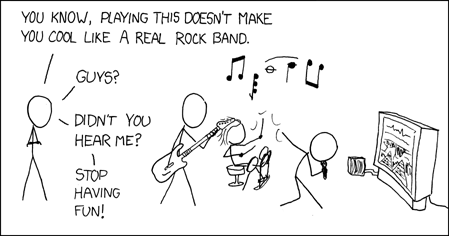
[xkcd]
When I tell people that I’m doing research on Guitar Hero and Rock Band, I usually get one of three responses:
1. “But those games aren’t really musical, right? Isn’t it just pushing buttons in time?”
2. “Are you studying whether they get kids interested in playing real instruments? Because I read an article about how guitar teachers are getting a lot more students since that game came out.”
3. “I love those games! So, do you actually play? Like, for work?”
People who don’t already have personal experience with the games usually think it’s self-evident that Guitar Hero and Rock Band are only creating musical automatons who suffer from escapist delusions of rock stardom—or, as guitarist John Mayer has said, “Guitar Hero was devised to bring the guitar-playing experience to the masses without them having to put anything into it.” If I’m talking to a fellow ethnomusicologist, s/he often assumes that my project involves a critique of the games as the latest symptoms of the decline and fall of genuine musicality and DIY creativity. If there is a saving grace here, it can only reside in the possibility that the scales will fall from players’ eyes and they’ll be inspired to pick up real instruments: in the words of Sleater-Kinney guitarist/rock critic Carrie Brownstein, “[M]aybe by pretending to be in a band, there will be those who’ll find the nerve to go beyond the game, and to take the brave leaps required to create something real.”
My previous videogame project was on Grand Theft Auto, and there, too, much of the non-gamer media response revolved around the relationship between gameworld activities and “the real thing”—only with GTA, the winds of moral panic blew in the opposite direction. Clearly, games like this would inspire players to pick up a real gun or beat up a real prostitute. Think of the children, especially the underprivileged children! As Congressman Joseph Pitts (R-PA) asserted at a June 14, 2006, hearing of the House Subcommittee on Commerce, Trade, and Consumer Protection, “It’s safe to say that a wealthy kid from the suburbs can play Grand Theft Auto or similar games without turning to a life of crime, but a poor kid who lives in a neighborhood where people really do steal cars or deal drugs or shoot cops might not be so fortunate” (transcribed from television footage).

[Congressman Pitts]
This kind of “media effects” discourse is so well-established and pervasive that it took Guitar Hero and Rock Band in stride. Will these games save real rock music or destroy it? News at 11!
Come to think of it, Congressman Pitts’s logic might be a more persuasive fit for Guitar Hero than GTA: it does seem more likely that a wealthy kid from the suburbs would have the resources to move from playing a plastic controller to taking private lessons on a Fender.
But really, I think this obsession with the relationship between playing Guitar Hero or Rock Band and playing “real music” is missing the point. My standard strategy for explaining my research to those caught up in the effects debate is to point out that playing these games isn’t just like playing real instruments, but it’s nothing at all like just listening to music. It’s a third thing, a new way of musicking. And if you want to get involved in value-oriented debates about it, here’s a thought experiment: rather than concluding that Guitar Hero players are wasting the time that they would otherwise be putting into long hours of practice on a real guitar, consider the possibility that they might otherwise spend that time just listening to recorded music (or, of course, playing Grand Theft Auto). Anyone who has played Guitar Hero or Rock Band for more than five minutes will tell you that it requires a deeper level of musical engagement than listening to an iPod—intellectually, emotionally, physically, and often socially. Moreover, everyone I’ve interviewed for my research reports that the games have substantially changed the way they listen to popular music when they’re not playing. This has certainly been the case for me; after playing drums in Rock Band I started to hear and understand drum parts in a totally new way (forever altering my visceral reaction to heavy metal, for instance). I’ve been running an online survey about the Guitar Hero/Rock Band gameplay experience, and so far 79% of my 480 respondents have indicated that the games have increased their appreciation for certain songs or genres; 75% have added new music to their listening collections because of the games. (A few more stats appear here.)
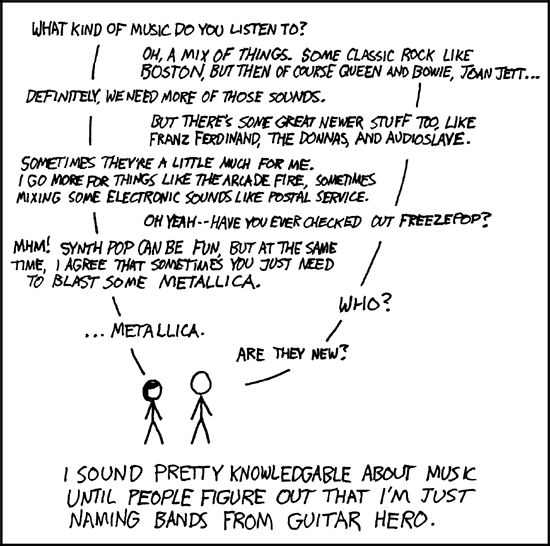
[xkcd]
My survey statistics only reconfirm what the music industry already knows: these games have created a huge market for value-added versions of previously recorded popular music. Every song licensed for release in the Guitar Hero and Rock Band games has been broken down into parts and transcribed at four different difficulty levels, creating a new, hard-to-pirate digital music product. Once players have bought a game and a set of instrument controllers, and have invested the time required to achieve proficiency on one or more instruments, they are happy to spend money on new repertoire. (This is a venerable business model; in the nineteenth century, once a family had a piano in the house, they gladly kept buying four-hand piano transcriptions of the latest symphonies and chamber music for parlor entertainment.) In March 2009, Harmonix announced that the Rock Band franchise had surpassed one billion dollars in North American retail sales revenue in 15 months, including over 40 million paid downloads of individual songs. In September, Harmonix will release The Beatles: Rock Band, an extraordinary licensing coup—the Beatles back catalog can’t even be purchased on iTunes yet.
The transcription work, scoring mechanism, and on-screen avatar band are the obvious components of the value-added, of course, but I want to suggest that the most important value-added aspect is the potential for performance. Actually, the term “value-reconstituted” might be more appropriate: you reconstitute instant soup by adding water, and you reconstitute a recorded song by adding performance. In both cases, the quality of the original ingredients makes all the difference. Guitar Hero and Rock Band let players put the performance back into recorded music, reanimating it with their physical engagement and performance adrenaline. Players become live performers of pre-recorded songs, a phenomenon that I call schizophonic performance. Unless I’m off-campus, in which case I just call it a lot more compelling than listening to a recording.
Value-reconstituted songs make some people very uncomfortable, because rock music is supposed to be über-authentic hard work. Instant fame is only for industry-manufactured sellouts, and hitting buttons on a plastic controller to release someone else’s hot guitar solo seems a lot like lip-syncing—it’s not even as authentic as karaoke. But players aren’t deluded; they’re quick to point out that they understand the difference between playing instruments and playing Guitar Hero. (It’s worth noting that 74% of my survey respondents have experience playing instruments; 49% have experience playing guitar). They know that the “instant” songs that they play in Guitar Hero and Rock Band are packaged, commercialized, and designed to be labor-saving, but that doesn’t spoil their musical experience. Just add performance, and the music blooms into new life.
***
When I tell people that I’m doing research on Guitar Hero and Rock Band, I usually get one of three responses:
1. “But those games aren’t really musical, right? Isn’t it just pushing buttons in time?”
2. “Are you studying whether they get kids interested in playing real instruments? Because I read an article about how guitar teachers are getting a lot more students since that game came out.”
3. “I love those games! So, do you actually play? Like, for work?”
People who don’t already have personal experience with the games usually think it’s self-evident that Guitar Hero and Rock Band are only creating musical automatons who suffer from escapist delusions of rock stardom—or, as guitarist John Mayer has said, “Guitar Hero was devised to bring the guitar-playing experience to the masses without them having to put anything into it.” If I’m talking to a fellow ethnomusicologist, s/he often assumes that my project involves a critique of the games as the latest symptoms of the decline and fall of genuine musicality and DIY creativity. If there is a saving grace here, it can only reside in the possibility that the scales will fall from players’ eyes and they’ll be inspired to pick up real instruments: in the words of Sleater-Kinney guitarist/rock critic Carrie Brownstein, “[M]aybe by pretending to be in a band, there will be those who’ll find the nerve to go beyond the game, and to take the brave leaps required to create something real.”
My previous videogame project was on Grand Theft Auto, and there, too, much of the non-gamer media response revolved around the relationship between gameworld activities and “the real thing”—only with GTA, the winds of moral panic blew in the opposite direction. Clearly, games like this would inspire players to pick up a real gun or beat up a real prostitute. Think of the children, especially the underprivileged children! As Congressman Joseph Pitts (R-PA) asserted at a June 14, 2006, hearing of the House Subcommittee on Commerce, Trade, and Consumer Protection, “It’s safe to say that a wealthy kid from the suburbs can play Grand Theft Auto or similar games without turning to a life of crime, but a poor kid who lives in a neighborhood where people really do steal cars or deal drugs or shoot cops might not be so fortunate” (transcribed from television footage).

This kind of “media effects” discourse is so well-established and pervasive that it took Guitar Hero and Rock Band in stride. Will these games save real rock music or destroy it? News at 11!
Come to think of it, Congressman Pitts’s logic might be a more persuasive fit for Guitar Hero than GTA: it does seem more likely that a wealthy kid from the suburbs would have the resources to move from playing a plastic controller to taking private lessons on a Fender.
But really, I think this obsession with the relationship between playing Guitar Hero or Rock Band and playing “real music” is missing the point. My standard strategy for explaining my research to those caught up in the effects debate is to point out that playing these games isn’t just like playing real instruments, but it’s nothing at all like just listening to music. It’s a third thing, a new way of musicking. And if you want to get involved in value-oriented debates about it, here’s a thought experiment: rather than concluding that Guitar Hero players are wasting the time that they would otherwise be putting into long hours of practice on a real guitar, consider the possibility that they might otherwise spend that time just listening to recorded music (or, of course, playing Grand Theft Auto). Anyone who has played Guitar Hero or Rock Band for more than five minutes will tell you that it requires a deeper level of musical engagement than listening to an iPod—intellectually, emotionally, physically, and often socially. Moreover, everyone I’ve interviewed for my research reports that the games have substantially changed the way they listen to popular music when they’re not playing. This has certainly been the case for me; after playing drums in Rock Band I started to hear and understand drum parts in a totally new way (forever altering my visceral reaction to heavy metal, for instance). I’ve been running an online survey about the Guitar Hero/Rock Band gameplay experience, and so far 79% of my 480 respondents have indicated that the games have increased their appreciation for certain songs or genres; 75% have added new music to their listening collections because of the games. (A few more stats appear here.)

My survey statistics only reconfirm what the music industry already knows: these games have created a huge market for value-added versions of previously recorded popular music. Every song licensed for release in the Guitar Hero and Rock Band games has been broken down into parts and transcribed at four different difficulty levels, creating a new, hard-to-pirate digital music product. Once players have bought a game and a set of instrument controllers, and have invested the time required to achieve proficiency on one or more instruments, they are happy to spend money on new repertoire. (This is a venerable business model; in the nineteenth century, once a family had a piano in the house, they gladly kept buying four-hand piano transcriptions of the latest symphonies and chamber music for parlor entertainment.) In March 2009, Harmonix announced that the Rock Band franchise had surpassed one billion dollars in North American retail sales revenue in 15 months, including over 40 million paid downloads of individual songs. In September, Harmonix will release The Beatles: Rock Band, an extraordinary licensing coup—the Beatles back catalog can’t even be purchased on iTunes yet.
The transcription work, scoring mechanism, and on-screen avatar band are the obvious components of the value-added, of course, but I want to suggest that the most important value-added aspect is the potential for performance. Actually, the term “value-reconstituted” might be more appropriate: you reconstitute instant soup by adding water, and you reconstitute a recorded song by adding performance. In both cases, the quality of the original ingredients makes all the difference. Guitar Hero and Rock Band let players put the performance back into recorded music, reanimating it with their physical engagement and performance adrenaline. Players become live performers of pre-recorded songs, a phenomenon that I call schizophonic performance. Unless I’m off-campus, in which case I just call it a lot more compelling than listening to a recording.
Value-reconstituted songs make some people very uncomfortable, because rock music is supposed to be über-authentic hard work. Instant fame is only for industry-manufactured sellouts, and hitting buttons on a plastic controller to release someone else’s hot guitar solo seems a lot like lip-syncing—it’s not even as authentic as karaoke. But players aren’t deluded; they’re quick to point out that they understand the difference between playing instruments and playing Guitar Hero. (It’s worth noting that 74% of my survey respondents have experience playing instruments; 49% have experience playing guitar). They know that the “instant” songs that they play in Guitar Hero and Rock Band are packaged, commercialized, and designed to be labor-saving, but that doesn’t spoil their musical experience. Just add performance, and the music blooms into new life.
Subscribe to:
Posts (Atom)
